


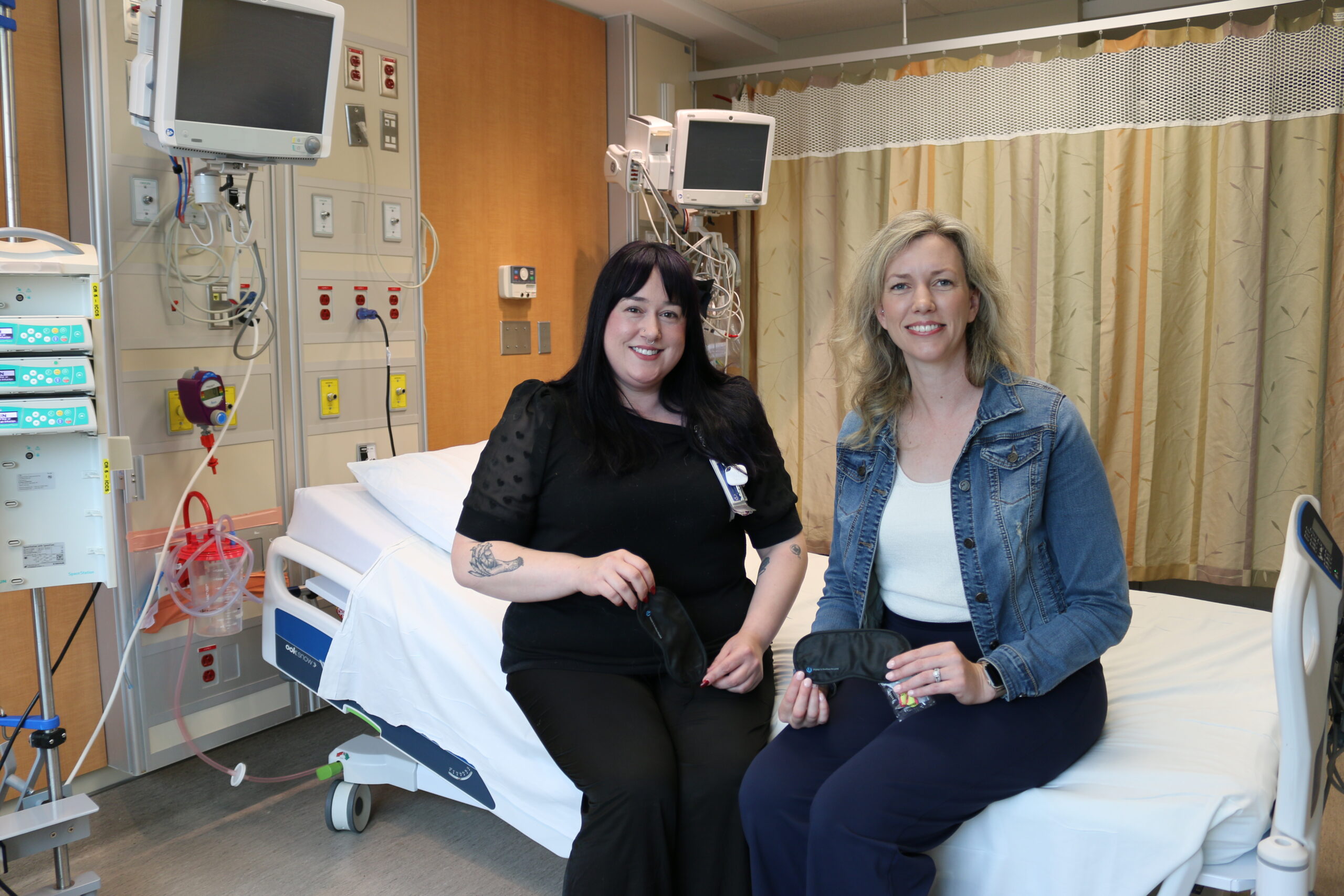
Catching zzzzs: Acute Cardiac Care Unit staff Brynn Lezak (left) and Kelsey Forest say new eye masks, earplugs, and a fresh staff perspective on rest are all helping patients to sleep better and recover more quickly.
October 14, 2026
Patients in St. Boniface Hospital’s Acute Cardiac Care Unit (ACCU) are getting more shut-eye thanks to a brand-new donor-funded project the unit launched last spring.
The idea is simple: sleep is an important part of healing, so help cardiac patients to sleep better by giving them earplugs and eye masks to wear and take home with them.
Patients are placed in the ACCU with heart failure, other non-surgical cardiac issues, or after a heart attack or cardiac arrest. The unit is small and relatively noisy, says Kelsey Forest, a Registered Nurse on the Critical Care Relief Team in all three Intensive Care Units at St. B.
“Some of the patients are very sick. So, there are alarms going off on the monitors. Every patient has a bedside monitor, and we try and reduce the alarms, but you can’t shut them off completely for safety reasons, of course,” said Forest.
“You hear beeping throughout the night. The monitors also blink, even if they don’t beep, sometimes they blink. So, there are lights on during the night. We do frequent checks on our patients too, interrupting their sleep to do our minimum hourly checks on them,” she added.
Masks and earplugs ordered
Based on research articles ACCU staff had read showing the benefits masks and earplugs could have in cardiac care, they ordered a year’s supply. They started handing them out to their patients in April 2026, with the goal of helping create a quieter, darker space so patients can rest and focus on healing.
Patients have been receptive to the project, says Brynn Lezak, Critical Care Clinical Educator for the unit. “We even had someone wear an eye mask to the CT scanner. They were anxious about going for a test and so they decided to wear it down the hall to their CT,” said Lezak.
“It has also opened conversations for those who don’t like it,” she said. “Like, ‘I don’t want to wear an eye mask, I’m claustrophobic,’ but would really like the fan. Or ‘It’s too hot in here.’ It has started that conversation to help them sleep better. Do they need a fan? White noise? A warm blanket?”
Better sleep can decrease a patient’s time on a ventilator in the ACCU. “Sleep helps them get out of unit faster. It helps them stabilize, and helps their heart heal,” said Lezak, adding rest can also decrease delirium in patients.
“Even if you’re getting a good night’s sleep, it helps you to participate in physiotherapy the next day,” continued Forest. “It makes you more able to participate in your care, whether it is physio, the teaching that we need to do with them, or just being awake during the day. You are functioning better, but there is also the medical side of it, which is the decreased recovery time.”
“Just simple things like lowering the blinds at night and opening them during the day, making sure patients are moving and active during the day so they can sleep more at night,” she offered.
Another part of the project is to try to cut down on interruptions at night if a patient is stable. Even sedated, intubated patients can benefit from this part of the sleep-improvement project, says Lezak. “Because they may look like they’re sleeping well, but they’re probably not,” she explained. (Sedated patients are not fitted with eye masks, to avoid alarming them if they were to wake up.)
“Sedation can affect your REM cycles, your sleep cycles, and everything. Even though they look like they’re sleeping, they’re not truly getting a restful sleep. And they might even be somewhat aware under the sedation. So, if we’re banging around there at night or have the lights on at night, that can affect their rest and will impact them when they wake up,” she said.
Project a success so far
The ACCU has already worked with St. B’s Quality Improvement Unit to survey patients about the impact the project has had on their self-reported sleep scores, compared with before.
“It’s a small group and we don’t have a lot of data yet, but so far we’ve seen a significant improvement in their sleep scores,” said Lezak. “We also asked some questions about if they can’t sleep, what is the problem? Is it the beeping equipment or other noises? Is it the lights?”
“Part of the sleep project wasn’t just the masks, but it was education around sleep. Honestly, just being mindful of patient sleep and how important it is, bundling care,” she said.
Staff response has also been positive. “It also sparked a lot of other conversations about sleep. For example, we mentioned the monitors light up. So, we’re working with the monitor people to ask, do they have to light up? Can we choose to turn the lights off? Staff have had really, really good ideas about how to further improve sleep.”