



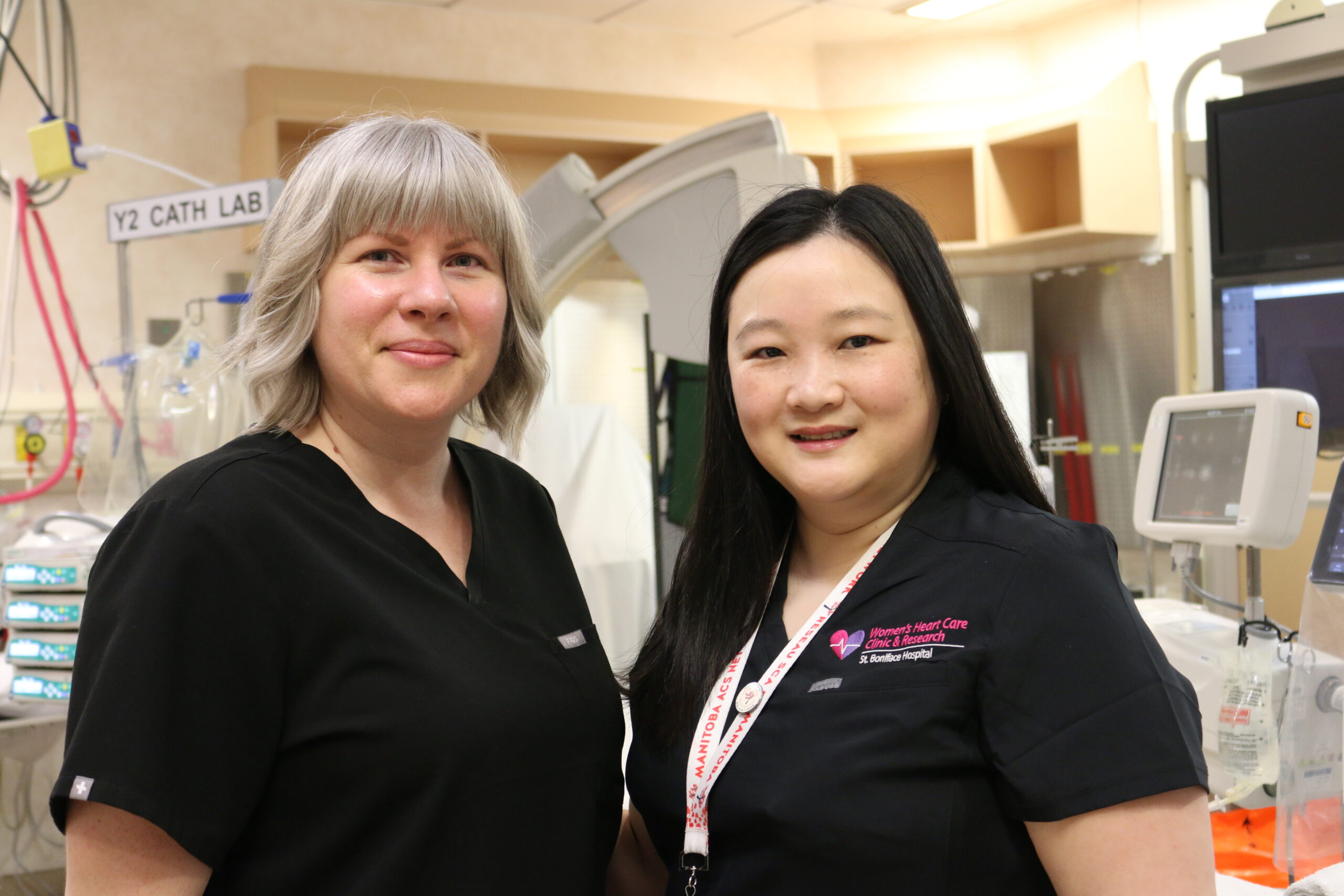
From left: Andrea de Haan, Research Coordinator, and Dr. Shuangbo Liu, Interventional Cardiologist, are getting ready to launch a new clinical testing and research program at St. B.
May 29, 2026
Dr. Shuangbo Liu and Andrea de Haan are hoping to answer some big medical questions by looking at the tiniest blood vessels of the heart.
Dr. Liu is an Interventional Cardiologist and the Interventional Cardiology Research Director at St. Boniface Hospital. She also holds national leadership roles in women’s heart health. De Haan is a Research Coordinator for Interventional Cardiology at the Hospital.
Thanks to support from donors like you, they are getting ready to launch a new clinical testing program later in 2026 – with an integrated research component – from the Bergen Cardiac Care Centre at the Hospital. The testing at St. B will be the first of its kind offered in Manitoba.
Condition causes chest pain, discomfort
Through the program, Dr. Liu and de Haan hope to learn more about a condition called coronary microvascular disease. It affects women at a much higher rate than men, they say, and needs to be studied.
“It has been around for many years. It was first described 50 or 60 years ago, and we still don’t fully understand it. We don’t know what the best way is to treat people after they are diagnosed,” explained Dr. Liu.
The disease is characterized by a dysfunction in blood vessels of the heart that are smaller than the naked eye can see.
“These vessels play a very important role because they are responsible for opening and closing to regulate blood flow to the muscle of the heart. So, they’re the very last layer of vessels before blood gets into the heart muscle itself,” said Dr. Liu.
“If someone is exerting themselves; if they’re going up the stairs, the normal response is your blood pressure and heart rate would go up. Your heart says, ‘Hey, I need more blood. If you want me to pump out more, my muscle needs more blood.’ In coronary microvascular disease, the very small blood vessels are not opening properly to allow more blood through. Instead, they are doing the opposite and clamping down so blood does not get through. Patients then experience chest pain and discomfort.”
Flare-ups can last from hours or days to months. Dr. Liu’s patients know to call her for help. “They just need to know this is unlikely to cause a heart attack. They’re not going to die from this, but we need to figure out what’s going on,” she said.
Sometimes it can also happen at rest, which makes the condition confusing. Many patients with the disease were previously healthy and living full and active lives, she notes. “That’s why we need to do the research because it can happen in isolation where we don’t have an obvious trigger,” she said. “It could be viral. Diabetes is a common risk factor for it. Anyone who has heart disease would be at risk for it. But it seems to be more prominent in young to middle-aged women.”
“There are many different subtypes and patients don’t fit necessarily into neat little boxes.”
 Patients sent out of province
The day procedure is called coronary reactivity testing, and it measures how the tiny vessels react to different situations. Dr. Liu expects the program to welcome approximately four to five patients per dedicated testing day in the Cardiac Catheterization Laboratory (Cath Lab) at the Hospital. (The Cath Lab team is pictured at left.)
In the procedure, Dr. Liu threads a catheter and a coronary wire up either through the patient’s wrist or leg, to the heart. “It’s a little bit different than an angiogram and takes longer. There are certain medications we give to try to provoke a response,” she said. “We put a very small wire into the artery of the heart, and we see if the patient’s body responds in the way that we expect it to.”
Until now, Dr. Liu has sent patients to Regina, Edmonton, Toronto, and elsewhere. “From a Manitoba perspective, we’ve had to send at least 20 patients out of province in the last few years. I have personally sent four or five, I believe, and I have a list of 10 patients who are waiting for testing,” she continued.
“I have at least three or four patients who don’t want to leave the province for testing because they can’t afford it, or they can’t take time off, or they have no one to go with them. They’re scared. They want to have the testing done at home.”
With the support of Dr. Kunal Minhas, Cardiac Cath Lab Director, Dr. Anita Soni, Medical Specialty Lead, Cardiac Sciences St. Boniface Hospital, and Reid Love, Director, Health Sciences – Cardiac Sciences Manitoba, the coronary microvascular disease program will be starting later in 2026.
Program an opportunity for research
With the new program taking shape, Dr. Liu and de Haan decided to set their sights higher. “We thought, if we’re starting the clinical program, why don’t we build research into it? Because patients want answers. We want answers,” said de Haan. She notes there are national registries to which the program will contribute data. There is also similar research taking place at labs in the US.
“First, we wanted to study what type of microvascular disease do patients have and what are their outcomes,” she explained. “What’s their prognosis? How often are they going to the Emergency Department needing urgent care? What are their rates of having a heart attack, a stroke, or of dying from this? We want to start our local registry here at St. B.”
“We also wanted to study the impact of this on their quality of life, and on anxiety and depression.”
To that end, Dr. Justin MacKenzie, a Clinical Psychologist, will also play a role in the research. “Any time someone has a chronic condition, it can affect your life in ways other than physical chest pain; for example, your relationship with others. Dr. MacKenzie does a lot of research in terms of the relationships with patients and caregivers. We are going to build that into our research as well,” said de Haan.
Furthermore, the program will prompt a new biobank at the Hospital. “So, collecting blood samples from patients at each of the different time intervals: before they go for testing, and when they’re having a flare-up. And then talking to our colleagues about identifying biomarkers to understand why people have good days and bad days, good months and bad months,” explained Dr. Liu. “Are there triggers that we don’t understand? Some inflammation? Some underlying protein or lipids that are causing this to happen?”
Dr. Liu says she and de Haan have roped in Dr. Amir Ravandi, an Interventional Cardiologist, Clinician Scientist, and Principal Investigator at St. B’s Institute of Cardiovascular Sciences, to do lipidomic testing. Another collaborator, Dr. Bram Ramjiawan, Director of Research, Asper Clinical Research Institute and Director of Research Innovation and Regulatory Affairs, will help oversee the biobank.
Speak up for women’s heart health. Give today.