



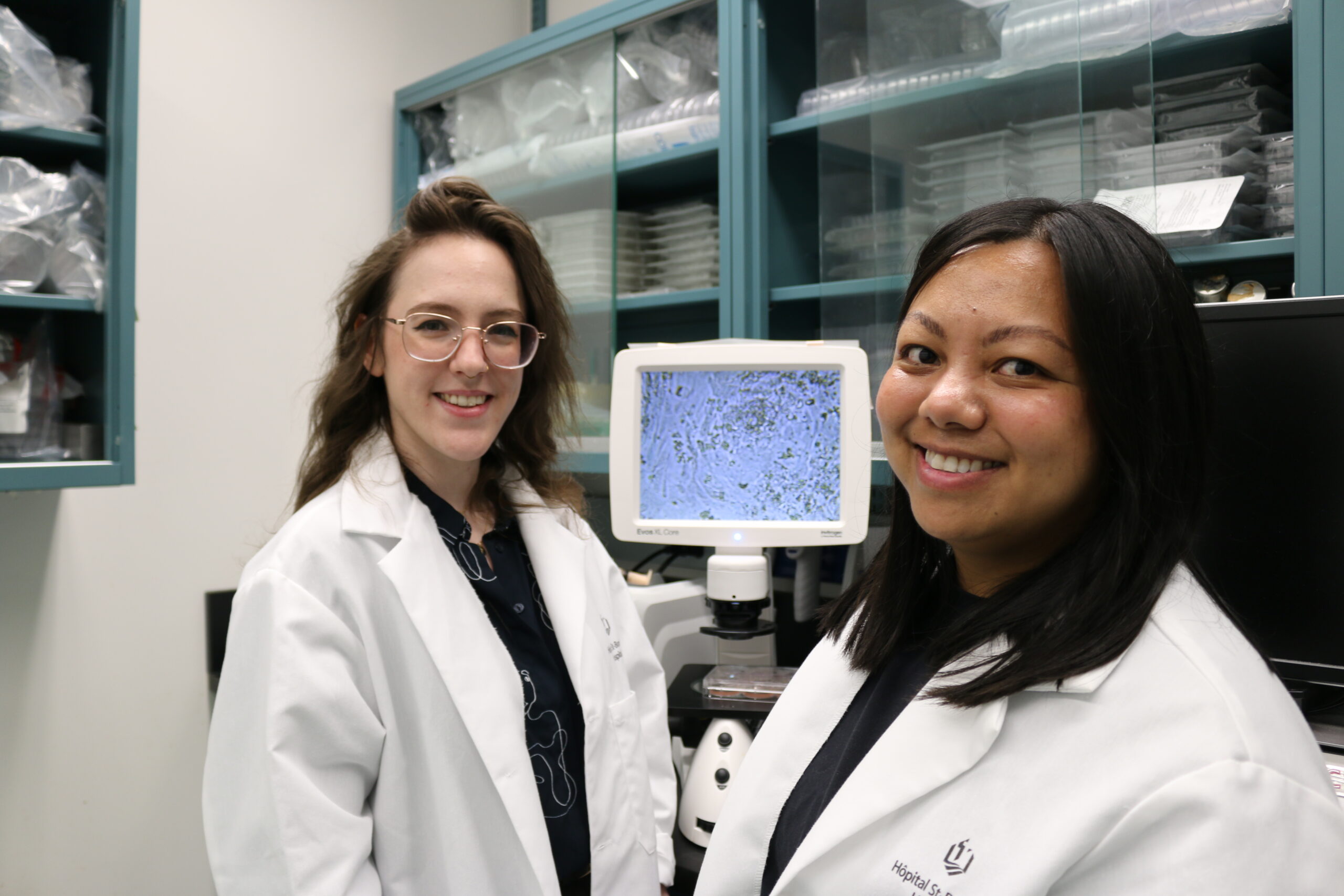
PhD student Roni Armon (left) and postdoctoral fellow Dr. Crystal Acosta are looking into ways of managing atrial fibrillation with their donor-supported experiments in St. Boniface Hospital’s Albrechtsen Research Centre.
October 14, 2026
The next generation of researchers in St. Boniface Hospital’s Albrechtsen Research Centre is looking at ways cannabinoids may protect the heart from atrial fibrillation (AFib), the most common form of irregular heartbeat or cardiac arrhythmia.
But it is not what you might be thinking.
“We do not study cannabis,” explained PhD student Roni Armon, who is in her third year at the University of Manitoba’s College of Pharmacy. “I know why people get it confused, because cannabis does contain cannabinoids.”
“But actually, cannabinoids are just naturally occurring substances that interact with receptors within our bodies. There are phytocannabinoids (THC, CBD) from a plant source like cannabis; endocannabinoids which are produced within our bodies; and synthetic cannabinoids which are produced in a lab,” she said.
The substances help regulate some of our body processes like with blood pressure, pain signaling, or memory signaling. “The chemical compound that we are interested in is a synthetic cannabinoid. And it’s a special one because it has very little access to the brain, and that minimizes the chance of psychoactive effects,” she added. The compound acts mostly at peripheral receptors outside the brain, she explained, meaning she can study its effect on the heart, specifically.
Potential drug may protect heart in the future
Under the supervision of Principal Investigator Dr. Hope Anderson, Dean, College of Pharmacy, Armon and postdoctoral fellow Dr. Crystal Acosta have been looking into the intricate details of AFib: “How does it happen? Why does it happen? What specific signaling pathways can we attack to manage against this problem,” asked Armon.
As a former paramedic, Armon saw firsthand the devastating effects AFib had on her patients. Armon notes the risk to develop AFib doubles with every decade of life. Approximately one to two per cent of the population live with it.
The answers could lie in synthetic cannabinoids she and Acosta test on simulated atrial heart cells, once reprogrammed stem cells that began as skin cells.
“Maybe one day, people with risk factors that show the tendency to develop AFib will have another tool to protect their hearts.”
“Our lab had shown previously that administration of this synthetic cannabinoid protects the heart from the harmful effects of certain substances,” she said. “These are certain hormones within our body that can cause cardiac remodeling, which are changes to the heart size, shape and function that can cause or contribute to atrial fibrillation.”
“So, administering this potential drug to the heart or to cardiac cells, both the organ and the cells, has helped to attenuate the harmful effects of these hormones. Eventually we are hoping to report that it will help protect the heart against atrial fibrillation.”
AFib has no cure
“This is a very promising pathway because it does show significant successes in our research in atrial heart cells. If that works, we dream that it can lift so much of the burden from those patients at risk of developing AFib or already living with it. It can give them the ability to live long healthy lives,” said Armon.
“This idea sounded like magic to me: trying to find, I won’t say a cure, but a way to manage and even prevent AFib using potentially new kind of drug. Maybe one day, people with risk factors that show the tendency to develop AFib will have another tool to protect their hearts. Or if they have already had an episode, protect the heart from deteriorating or the situation from deteriorating,” she explained.