



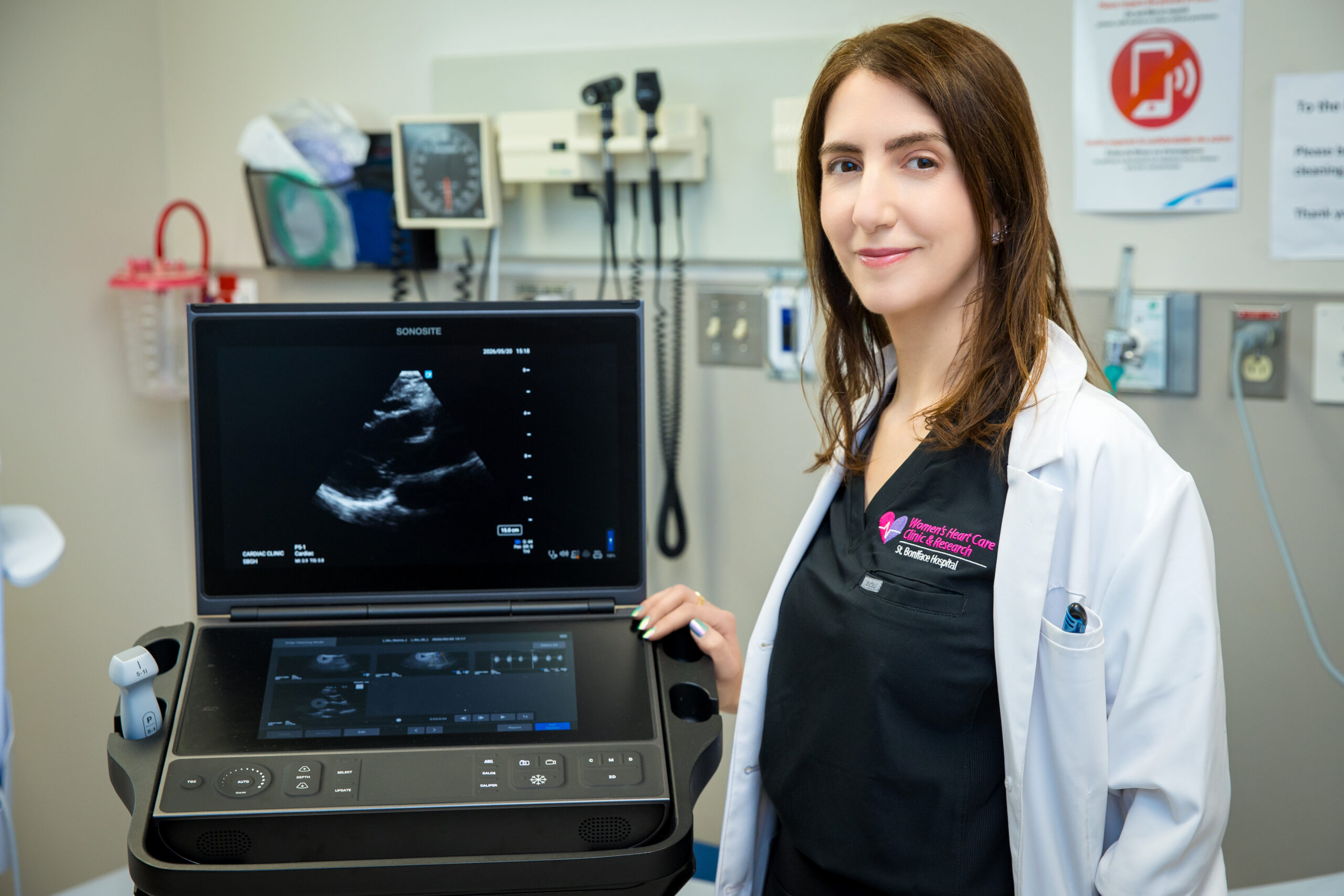
Dr. Robin Ducas, Cardiologist and Medical Lead for the Cardio-Obstetric Clinic, with a Sonosite PX ultrasound machine like the new one destined for St. Boniface Hospital’s Women’s Heart Care Clinic and Research.
July 27, 2026
A Cardiologist in St. Boniface Hospital’s Women’s Heart Care Clinic and Research says she will be able to provide pregnant and new mothers with quicker and more detailed assessments of their heart health thanks to the kindness of Foundation donors.
A new, mobile point-of-care ultrasound (POCUS) device funded by donors will maximize St. B’s resources while reducing the need for patients to come in multiple times, says Dr. Robin Ducas, an expert in the emerging field of cardio-obstetrics, also called maternal cardiology.
“It’s basically the field of cardiology where we care for women pre-conception, during pregnancy, and postpartum when they have heart disease,” explained Dr. Ducas, who is a Cardiologist, Medical Lead for the Cardio-Obstetric Clinic, and Medical Director for the Adult Congenital Heart Disease Program at the Hospital.
The POCUS will give Dr. Ducas an easier way to perform a quick heart ultrasound, or echocardiogram, to check on a patient’s heart function.
“If we find something on physical exam or patient history that makes us concerned about a structural heart problem that would affect the patient’s care, usually we would order a full echocardiogram,” she said.
 POCUS provides quick answers
Patients often have to wait or come back for the echo, however. “That resource is limited,” she explained. “There is a wait list, with urgent patients being prioritized. If a person needs a full echo, they will certainly accommodate in a reasonable amount of time,” she added.
“But when I am seeing somebody in clinic and I have this machine at my fingertips, it’s a lot better because I can give them an answer right away. Like, ‘It looks fine, we don’t need to order another test right away,’ or ‘It’s worth bringing you back.’ The POCUS answers that question quickly.”
If Dr. Ducas hears something with her stethoscope that may indicate a valve problem she wants to check on more closely, she will use the POCUS. “I can take a look and quickly confirm it,” she said.
The POCUS will also let her see things she cannot identify using only a stethoscope. “On an average physical exam, I might not be able to hear that somebody’s heart pump function has dropped…but being able to look at the ultrasound images and do those measurements can give me that clue that something has changed.”
“When I’m seeing somebody in clinic and I have this machine at my fingertips, it’s a lot better because I can give them an answer right away.”
“If all I want to know is whether their heart function is the same, or their valve is the same, as before, I can answer that myself using the POCUS. It’s also quite useful in serial studies; if I have a patient that I’m going to be seeing every couple of weeks because they’re very complicated, and I just want a quick check on what the pressure is in their heart or how strongly their heart’s pumping or how leaky their valve is, I am able to do that on my own without having to ask for a full echo or even a limited echo every week,” said Dr. Ducas.
Every patient’s journey is different, she said. “There are people that I follow for congenital heart disease that want to become pregnant. So, I will do the preconception counseling. I’ll help manage them throughout their pregnancy. And then other times, I’m referred people because they have a new problem in pregnancy, or in the postpartum period they develop heart failure.”
Dr. Ducas also sees pregnant women with a variety of different heart disease, congenital heart problems, and heart rhythm problems or heart failure caused by pregnancy. “And so, it is a dynamic clinic, because you never know what you are going to get. Having the ability to image people at the time of clinic can really help triage their care.”
Device helps with patient-centred care
Cardio-obstetrics is a fast-paced and growing program. “I thought I would only have to do a clinic once a month, and now it’s about a once a week,” she noted, adding she cannot have a long wait list: “You can’t see the patient in six months when they’re pregnant.” As such, she tries to keep her practice focused on patients with more complex conditions.
In addition to getting more referrals, Dr. Ducas says she’s busy because an increasing number of women are living longer and reaching childbearing age despite having heart disease.
“There are also more people that are having pregnancies later in life after developing acquired heart disease such as heart failure or heart attack,” she continued. “And with more use of assisted reproductive technologies like IVF, there are people that otherwise may not have been getting pregnant who now are.”
Dr. Ducas notes “a good number” of her patients live outside of Winnipeg. “And if they have complicated heart disease, as it gets towards the end of their pregnancy, there are a lot of obstetrical visits, cardiology visits, visits for multiple reasons. So, if I can minimize the number of times that they have to disrupt their life to get health-care contacts but still provide them all the care that they need, I think that’s a win-win.”
The POCUS provides quicker answers, she says. “The ability to triage and identify people that we can escalate their care faster is helpful. So, I can identify somebody who really does need a shift in their care to either bring them in as an inpatient, or start a new medication, or do some more advanced or invasive testing.”