



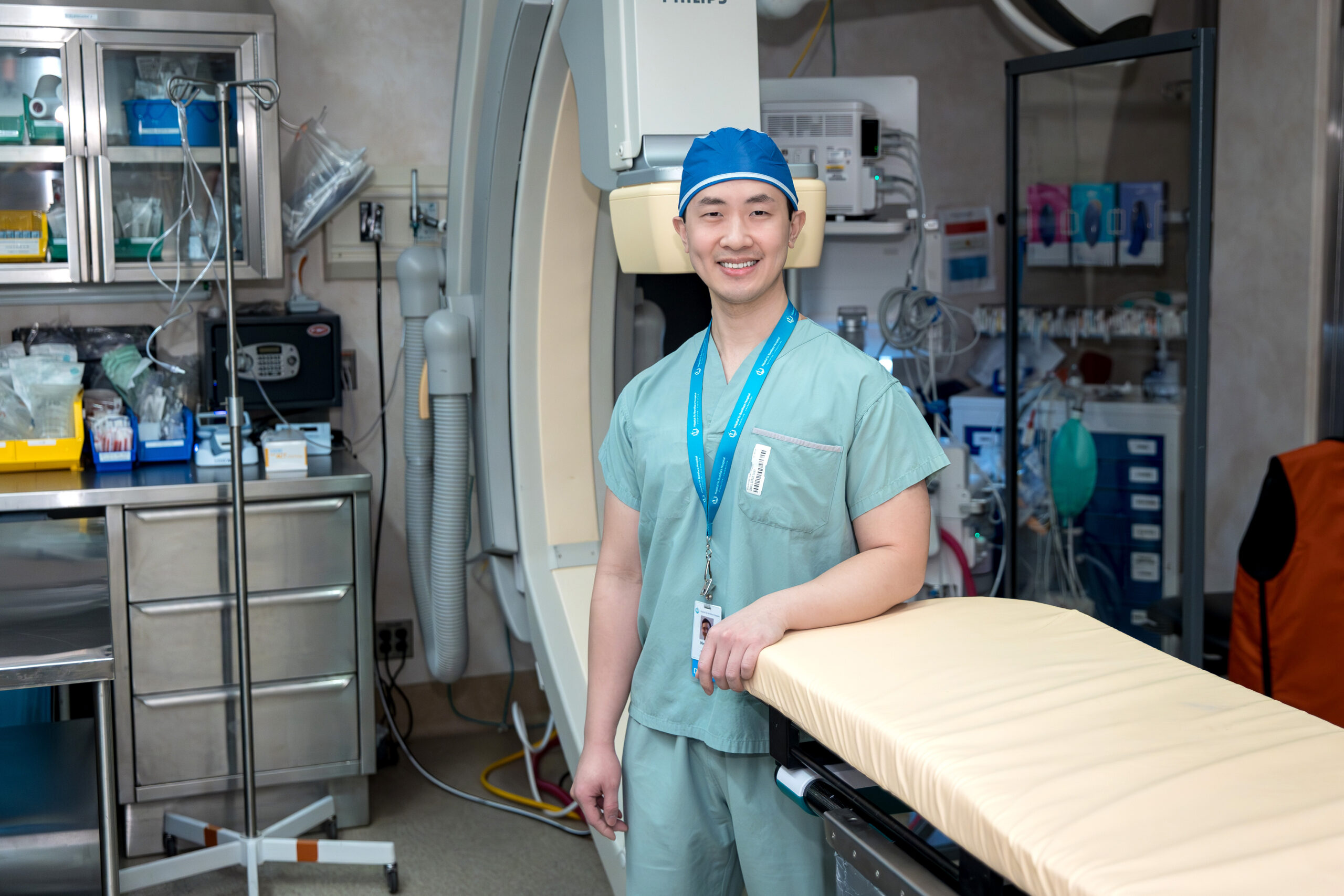
Cardiac electrophysiologist Dr. Vincent Le says the future redevelopment of the EP Lab at St. B will change the ways the Hospital can offer procedures.
June 12, 2026
Dr. Vincent Le is looking forward to performing his first pulsed field ablation in Winnipeg thanks to you.
Born and raised in Ottawa, Dr. Le is a cardiac electrophysiologist in the Section of Cardiology at St. Boniface Hospital. He started in September 2025, having come here from Calgary. He was trained in pulsed field ablation and has performed the procedure at another hospital.
With funding from donors like you secured, Cardiac Sciences at St. Boniface Hospital has scheduled its outdated, cramped Electrophysiology (EP) Lab in the Bergen Cardiac Care Centre for redevelopment starting in 2026.
An ablation treats atrial fibrillation (AFib) surgically by using energy, either burning or freezing, to destroy small areas of heart tissue responsible for heart rhythm abnormalities.
“Pulsed field ablation uses a new technique with electrical fields to make small holes in cells that will then destroy the cells. And so far, this technique has been shown to be safer overall for patients with fewer significant complications,” he said.
“It delivers energy in a way that’s safer for patients,” he continued. “Pulsed field ablation helps avoid a lot of the significant complications that we could see with our traditional heat or cold methods.”
“Having pulsed field ablation has been shown to increase capacity for performing certain types of ablations at other centres. So, I can see that happening here in Winnipeg as well.”
 Exciting changes coming
Cardiac Sciences’ old 352-square-foot EP Lab opened 20 years ago. It has barely enough space for the essential medical equipment and staff needed to treat patients and it cannot adequately support newer, more complex procedures like pulsed field ablation, explained Dr. Le.
The redeveloped lab is planned to be nearly double in size. “We will appreciate the added space, especially since a lot of the new technologies involve some amount of physical equipment,” he said.
“Overall, I am really looking forward to having the new EP lab. There are a lot of exciting changes in the field of electrophysiology, and I think having the new EP Lab will allow us to more easily bring these innovative new tools to make a big impact on better long-term outcomes for patients.”
The field of electrophysiology is advancing rapidly, says Dr. Le. “There have been a lot of innovations in the field of ablation of abnormal heart rhythms, as well as cardiac implantable electrical devices.”
“Other new technologies for cardiac rhythm management includes leadless pacemakers that the new EP Lab will allow us to bring to Winnipeg more easily.”
Dr. Le calls his job at the Hospital challenging, but in a good way.
“One of the reasons why I chose to come to Winnipeg is it provided a meaningful opportunity for me to use my skills and experience to directly impact and improve patient lives, both in the acute setting as well as in the chronic setting. And for me, that’s really rewarding, being able to serve my community using my expertise. I find that very fulfilling,” he said.