
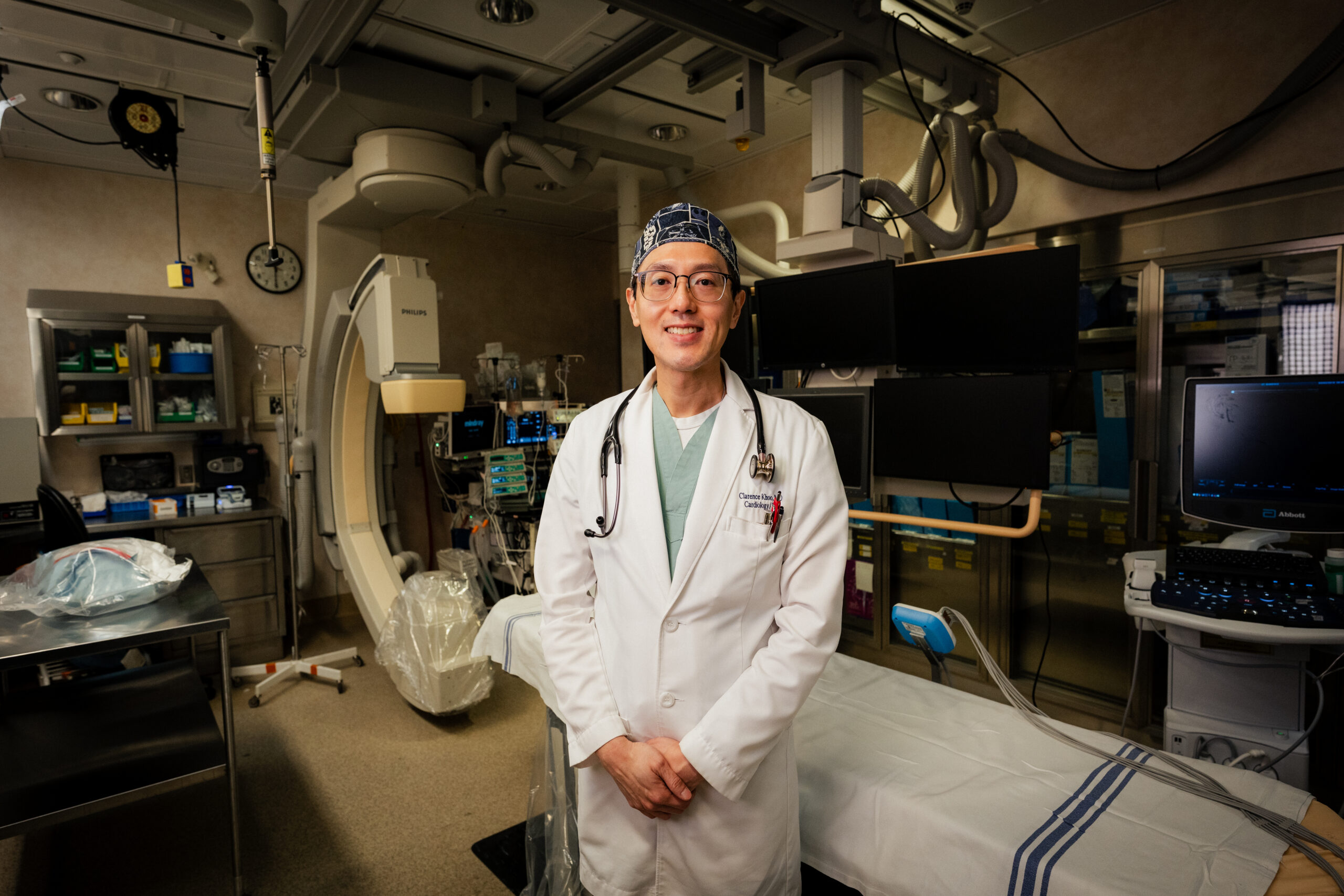
Dr. Clarence Khoo, Director of Arrhythmia Services, says a new EP Lab will bring care for Manitobans with irregular heartbeats into the future.
November 19, 2026
Science fiction is one of the factors that Dr. Clarence Khoo says inspired him to become an electrophysiologist in the real world.
Was it Dr. Leonard “Bones” McCoy, the Chief Medical Officer on Star Trek: The Original Series?
“I love science fiction,” said Khoo, the Director of Arrhythmia Services in Cardiac Sciences at St. Boniface Hospital. “The kid in me loves Star Wars, but the idealist in me likes Star Trek.”
Sci-fi often represents the hope that there’s something better in the future. That belief can apply to creating a healthier society for all Manitobans.
Meanwhile, futuristic medical technology doesn’t exist only in sci-fi movies, says Khoo, speaking about the Hospital’s Electrophysiology (EP) Lab redevelopment and expansion project currently underway.
“Imagine: ultrasound scanners that give unprecedented looks inside the human body. Delicate cardiac surgery performed with targeted electrical pulses. Wireless pacemakers that harness the heart’s natural electrical pathways,” said Dr. Khoo. “It sounds like what you would expect to find on the Starship Enterprise, but these and other advancements are, in fact, real.”
Five days a week, Dr. Khoo and his colleagues perform ablations in the outdated and cramped EP Lab in the Hospital’s Bergen Cardiac Care Centre to correct atrial fibrillation (AFib) and other irregular heartbeats. In another part of the EP Lab, they also install devices like pacemakers and defibrillators that help to regulate heart rhythms. (And, yes, some are even wireless now!)
The Hospital built the EP Lab almost 20 years ago now, in a time and era where no one could predict how much technology would be available today. “So, at the time it was a reasonably sized, effective space for what we needed to do at that point,” explained Dr. Khoo.
“But technology has only grown. The equipment's more sophisticated, requiring more space as well. More computing power is required. Over the last decade or so, the space we have has become insufficient for what we need. Equipment now spills over, outside the room, into the hallways. We have to wheel things in and out,” he said.
Pulsed field ablation the future
A new technology called pulse field ablation is an example of what the future can hold for patients at St. B.
An ablation treats AFib surgically by using energy (currently either burning or freezing) to destroy small areas of heart tissue responsible for the abnormal rhythm. The next generation is pulsed field, where physicians like Dr. Khoo can get away from using physical heat or cold energy to damage the heart tissue. Instead, they can encourage the heart tissue to, essentially, give up and die in the areas that they want to ablate.
“It's interesting, because the technology was initially developed to treat cancer,” he said. “Scientists realized very early on that if you deliver electrical impulses in a very specific way, in a very specific pattern, you could open little pores in the walls of cells, through which they introduced chemotherapy drugs at the time.”
“They realized that if you then applied enough of these pulses, with a very specific frequency, you could open so many pores, in so many cells, that they could encourage these cells to then undergo programmed cell death. The cell goes like, ‘OK, I've received so much irreversible damage that I should give up and die.’ This lets us be very specific, and selective.”
Pulsed field ablation also only takes about half the time, or even less, than a traditional heat or cold ablation can take. “This will help us see more patients faster and clear the long wait times, while the new EP Lab is open for up to seven days a week instead of the current five,” he said.