



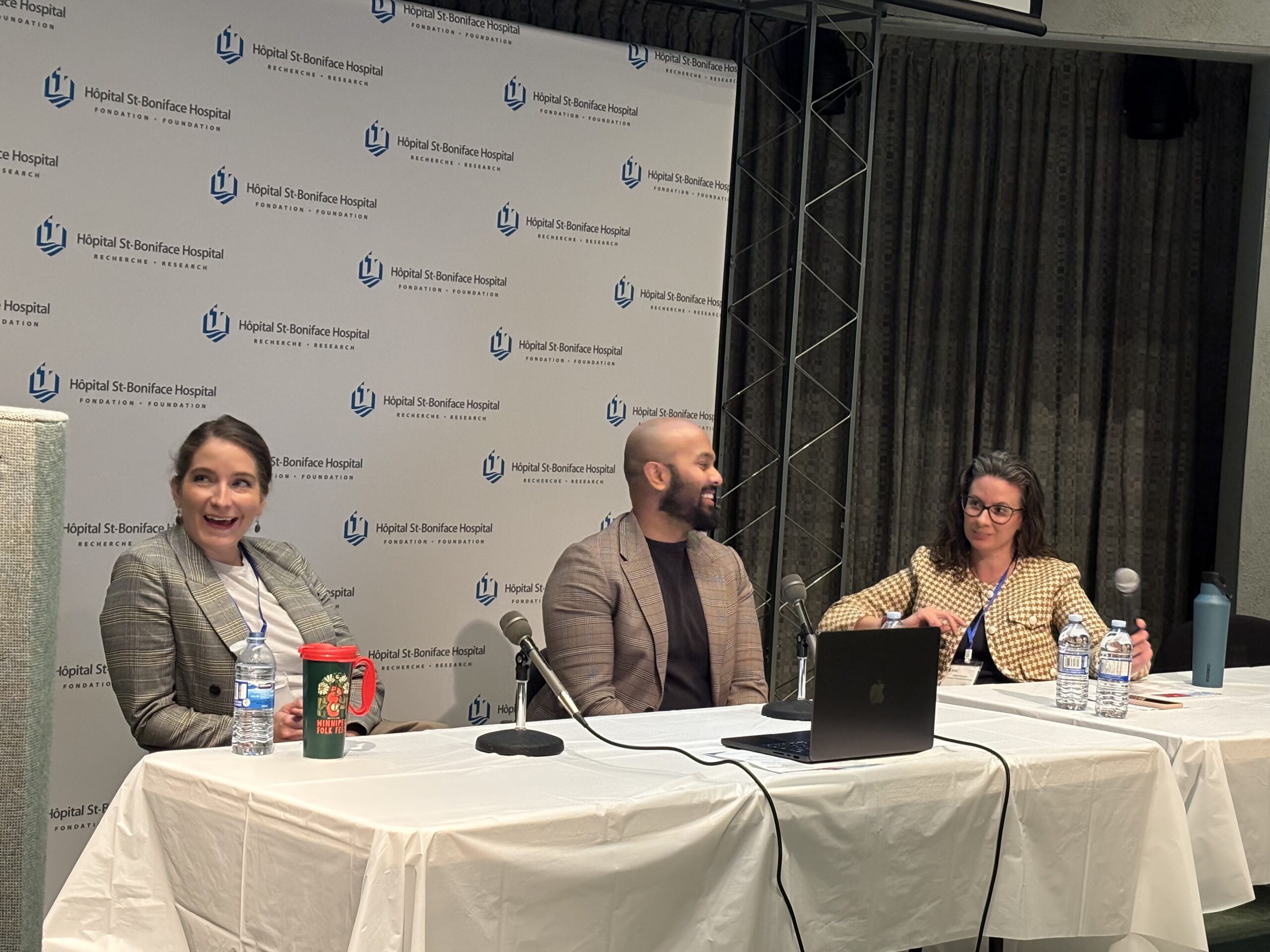
From left: Drs. Jessica Cudmore, Sandeep Krishnan, and Debra Evaniuk presented on Cardiovascular Risk in Women Across the Life Span at Heart Attack Day.
May 14, 2026
Can common events and conditions in a woman’s life lead to cardiovascular disease in her future?
Attendees discussed that and many other important patient care issues at the Manitoba Acute Coronary Syndrome (ACS) Network’s annual Heart Attack Day education forum, May 1, at St. Boniface Hospital’s Albrechtsen Research Centre. This year’s program explored Risk Through the ACS Journey.
The event, which started in 2017, invites physicians, nurses, and other health-care professionals from across Manitoba who work in clinical settings to gather and learn the latest and best in care for patients with heart disease.
Heart Attack Day is hosted by the Manitoba ACS Network, Cardiac Sciences St. Boniface Hospital, and the University of Manitoba. While the Foundation does not directly fund the event, support from donors like you drives women’s heart health research forward year-round, and leads to better patient outcomes through the latest and best possible cardiac care at St. B, through these organizations.
High blood pressure a risk factor
In a morning session titled Cardiovascular Risk in Women Across the Life Span, panelist Dr. Jessica Cudmore, a General Internal Medicine physician at St. B, talked about the risks posed by pre-eclampsia (high blood pressure) and related medical disorders of pregnancy.
“Pre-eclampsia offers a glimpse into the future cardiovascular health of women,” said Dr. Cudmore. She noted that younger and older pregnant women tend to be at a higher risk, as do Black and Indigenous women.
“We understand that there are many overlaps between pre-eclampsia and cardiovascular disease. Really it is the first presentation of a vascular disease in a woman’s life, in many cases,” she explained.
“Patients who have hypertensive disorders of pregnancy are more likely to have cardiovascular disease, and at an earlier age than most of us would suspect.” Depending on the severity of her pre-eclampsia, continued Dr. Cudmore, a woman’s risk of cardiovascular disease can increase by two to five times.
“Making sure that folks are aware of this is really important,” she told her audience. “Because often a mother’s pre-eclampsia resolves quickly after they have had their baby, and often they have many years of unimpacted health. It’s an opportunity to incorporate good health behaviours and screening practices moving forward.” These include healthy diet and regular exercise, she added.
 Spotlight on menopause care
As part of the same session, Dr. Debra Evaniuk (at left), Assistant Professor and Section Head of Menopause with the Department of Obstetrics, Gynecology and Reproductive Sciences at the University of Manitoba, talked about research into menopause, hormone therapy, and cardiovascular disease.
Dr. Evaniuk referenced the Women’s Health Initiative (WHI), a long-term American national health study that started in 1992. It focuses on strategies for preventing heart disease, breast and colorectal cancer, and osteoporosis in postmenopausal women.
The WHI study showed that the benefits of hormone therapy are more likely to outweigh the cardiovascular risks if started in symptomatic women at the right time in their lives.
“The concept here is that you need estrogen to be added to the right environment to be protective, but if added to the wrong environment it can be a problem,” she explained.
“Obviously there’s clinical judgement that goes into all of this,” she told her fellow physicians. “But, generally speaking, you’re quite safe from a cardiovascular risk standpoint to start hormone therapy in someone who’s seen their last period within the last ten years, or if they’re under the age of 60.”
At this year’s event, the Manitoba government re-proclaimed May 1 as Heart Attack Awareness Day. Carla Compton, who is both the MLA for Tuxedo and a registered nurse, was in attendance.
Give more families more tomorrows. Speak up for women’s heart health. Give today.