



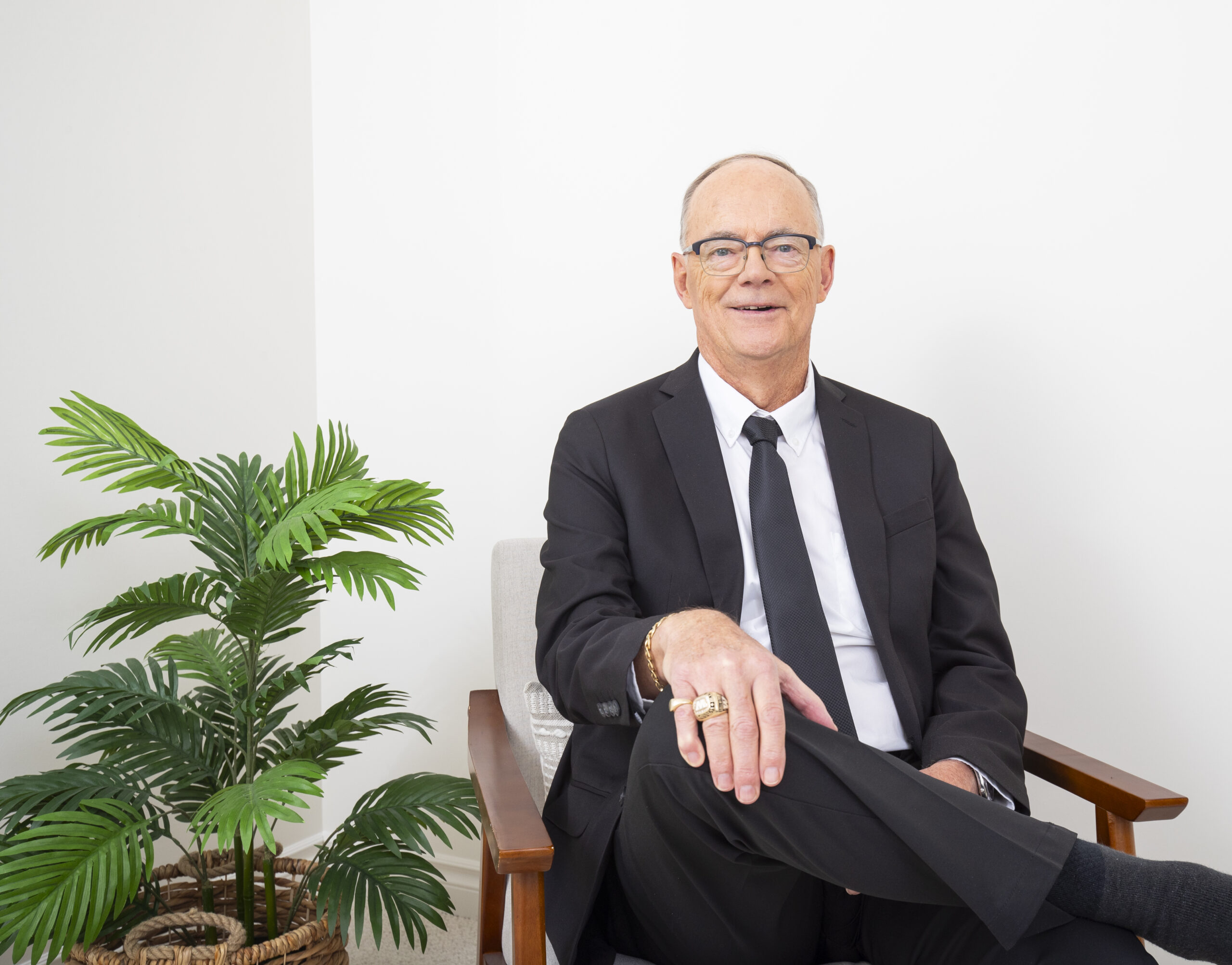
Legendary CJOB announcer Bob Irving called Blue Bombers games from 1974 to 2021.
January 8, 2025
They say the best in the game play with heart. Retired broadcaster Bob “Knuckles” Irving also knows a thing or two about what else makes a championship team – even those off the football field.
Irving is best known in Manitoba as the iconic voice of the Winnipeg Blue Bombers on CJOB for more than 45 years. His name became so strongly associated with the Bombers, in fact, the football club gave him his own Grey Cup ring in 2019 and later inducted him into the Ring of Honour at Princess Auto Stadium.
There is, however, another local team that is also near and dear to Irving’s heart (literally). They are his compassionate caregivers from Manitoba’s Cardiac Centre of Excellence at St. Boniface Hospital, who have guided him through a series of cardiac procedures over several decades.
“To me, St. B is my home when it comes to heart problems. I am thankful for all that the Hospital has done for me and done for many others,” said Irving.
“I think the Cardiac Sciences Program here at St. B is world-class, based on everything I’ve heard and I understand. We have some of the best doctors you could possibly get, and the cardiac research is fantastic. I think those of us who live in Winnipeg and have access to the care are truly fortunate,” he continued.
Heart issues kicked off early
Long before Irving ever called his first of more than 800 CFL games on the radio, he had open-heart surgery as a teenager in Regina to correct an atrial septal defect. His doctors diagnosed him with an irregular heartbeat, or arrhythmia, that he learned to live with.
“I had the surgery when I was 18. Then, with the irregular heartbeat stuff and all the rest of it, I knew that I was going to have heart issues for the rest of my life. So, I’ve just accepted what I was dealt and have made the best of it,” he said.
About 25 years ago, Irving started noticing his heart was racing more often. He had an episode while golfing, a favourite pastime, at Pine Ridge Golf Club in which he couldn’t get it to slow down.
“I had a thing where I could hold my breath or lie on my back for a few seconds, and it would go back to normal rhythm. But this day it wouldn’t, and for an hour and a half it was racing at about 130 to 180 beats per minute,” he said.
His friends rushed him to Concordia Hospital, where he was treated successfully. Irving started seeing a cardiologist regularly, who diagnosed him with atrial fibrillation (AFib), the most common form of abnormal heart rhythm, and atrial flutter, a related condition.
St. B tackles arrhythmias
 The cardiologist, and others after him, told Irving the situation with his heart is complicated. “I kept hearing that over and over, so many times over the years: complicated,” he remembered.
He went to the Mayo Clinic in Rochester, Minnesota, at his physician’s recommendation for further tests. They discovered Irving had a leaking tricuspid valve, which was repaired in 2002 through open-heart surgery back at St. Boniface Hospital.
Irving had ablations in St. B’s Electrophysiology (EP) Lab in 2007 and 2008. An ablation treats AFib surgically by using energy – either burning or freezing – to destroy small areas of heart tissue responsible for the abnormal rhythm.
He had another ablation at the Hospital in 2015 to correct atrial tachycardia, an abnormal heart rhythm causing a heart rate faster than 100 beats per minute. He had a pacemaker defibrillator installed at that time to help control the risks caused by a rare condition he has called ARVC (arrhythmogenic right ventricular cardiomyopathy).
Cardiac care is a team sport
“When you come into St. B for these procedures, the treatment you get is fabulous,” said Irving. “I don’t know what each patient’s expectation is, but you want somebody who’s caring and pleasant and friendly and all the rest of it.”
“I have nothing but wonderful things to say about the nurses. When you come in to have a cardiac procedure, they put you right in, get you on a on a bed, hook you up to an IV, and let you know what’s going on. Eventually, you go into the procedure room or the operating room, and again there, everybody’s positive and trying to make you feel good, as relaxed as you can feel.”
“As a patient, you couldn’t ask for anything more in my opinion, in terms of care.”
Not all the choices the care teams make are perfect, even at St. B. When Irving had an AV node ablation at the Hospital in 2024, he was surprised by the music playing in the procedure room when they wheeled him in.
“The song that was playing was Led Zeppelin’s Stairway to Heaven. I’ll never forget it,” he laughed. “I was under conscious sedation, right? And so, I asked, ‘Who’s in charge of the music?’ One of the nurses said, ‘Well, you are, Bob. What do you want to hear?’ I asked for Shania Twain instead.”
“As a patient, you couldn’t ask for anything more in my opinion, in terms of care,” he said. I have nothing but good memories about the way they treated me; it was all fantastic.”
Time left on the clock
Irving isn’t interested in self-pity. “I guess every now and then you can feel sorry for yourself, and you know, ‘Why me?’ and that sort of thing. But that passes very quickly, because you don’t have to look far to see somebody who’s worse off than you are,” he reflected.
“I am 75 years old now. I’ve gone through a bunch of stuff with my heart, but I’ve lived a fairly normal life, and I’ve travelled the world. I can still play golf and do some of the things I really like to do.”
“I’m sure I’ll be back to St. B many more times. Hopefully, that is, because that means I’m still alive.”