



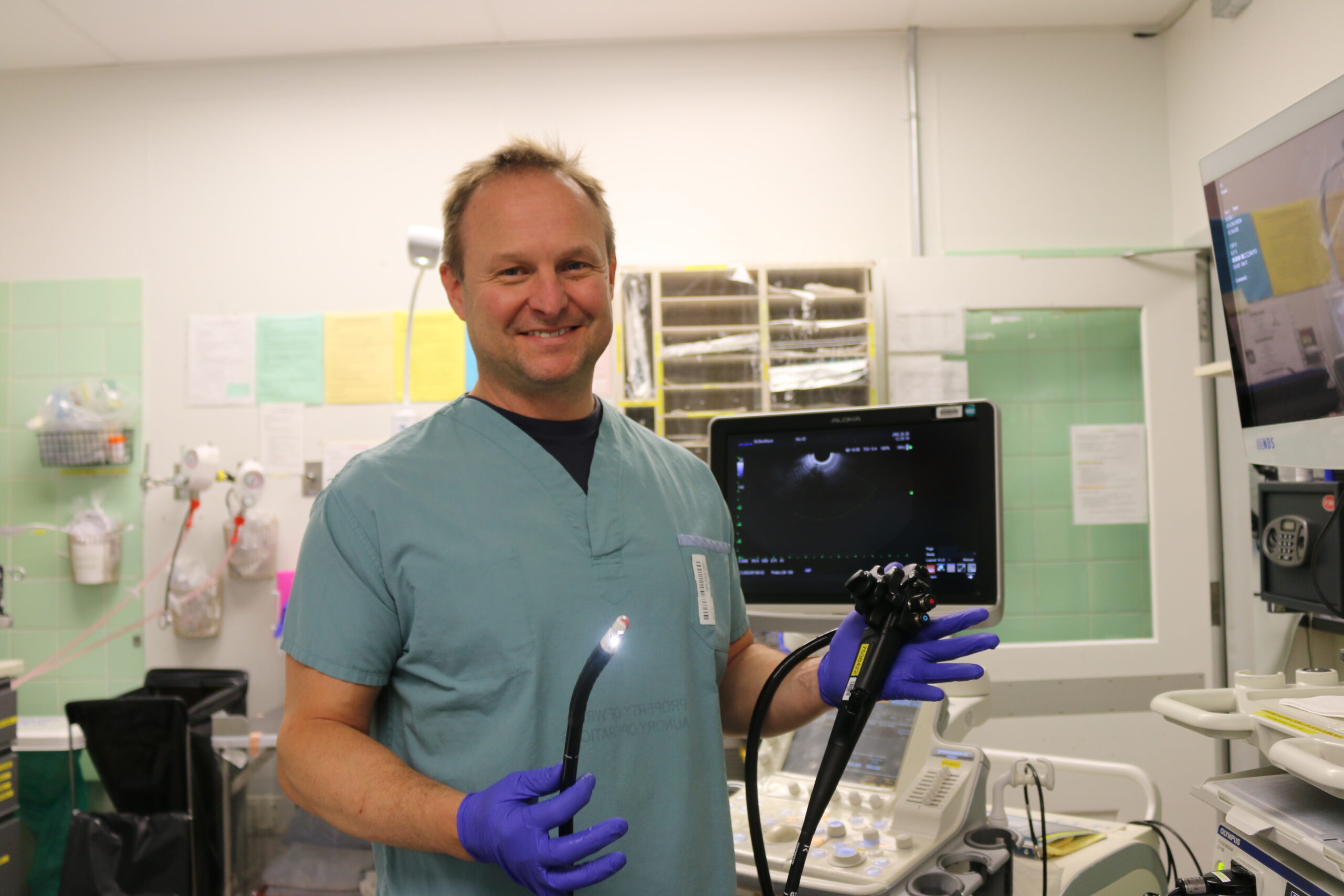
Dr. Dana Moffatt, Medical Director of Endoscopy, says the new endoscopic ultrasound at St. B is “real impactful technology…We are very, very happy to have it.”
February 18, 2026
The walls of the intestines are no longer a barrier for Dr. Dana Moffatt and his team at St. Boniface Hospital.
Thanks to leading-edge equipment funded by Foundation donors like you, the Therapeutic Endoscopy Team and Dr. Moffatt, who is a gastroenterologist and the Medical Director of Endoscopy at the Hospital, can now diagnose cancers in his patients faster, and more accurately.
Four new, reusable instruments called endoscopic ultrasound scopes (EUS) purchased using foundation funds were put into wide use in St. B’s Endoscopy Unit in September 2025.
“Traditional endoscopy is a long thin, flexible, tube-shaped camera that is inserted into the intestines. Traditionally, we look into the esophagus and stomach; or we look into the colon and rectum,” explained Dr. Moffatt. “With endoscopic ultrasound scopes we can still look inside the intestines, but at the tip of the scope there is also an ultrasound probe which allows us to see across the walls of the intestine and into adjacent organs,” he continued.
“So, we can go into the stomach and look at the pancreas. Or go into the rectum and look at the prostate or pelvic organs. And also, it allows us to look deeper into the walls of the intestines to stage cancers, or look between the layers,” he said, adding that before EUS, he relied more on additional testing like MRI or CT; therefore, sending patients back and forth between units.
The EUS scope also allow doctors to use a fine needle to obtain biopsies. “We can go into the pancreas or into the liver to get biopsies, which we can’t do with a regular endoscope. So, that’s important for quicker, more accurate diagnoses of cancers,” he said.
“The most important thing that patients will understand is that this is a way to rapidly diagnose tumors anywhere in the abdominal or chest cavities, as we’re doing a scope. We don’t have to send them for a surgical biopsy or MRI or CT-guided biopsy. We can do it at the same time.”
Dr. Moffatt can also use EUS to diagnose disorders such as stones in the bile duct or gallbladder. For the last 40 years of traditional endoscopy at St. B an X-ray based procedure, called ERCP, has been performed to cut open the duct and clean it out from the inside. The older procedure is more invasive, explained Dr. Moffatt.
“One of the real benefits of endoscopic ultrasound is that we can decrease the use of ERCP, because we can be more definitive, sensitive, and accurate in our diagnosis of bile duct and pancreatic problems. Previously, we often would just do the ERCP; sometimes you wouldn’t have a stone and sometimes you would. And so, we can be more judicious in our use of that more invasive procedure,” he said.
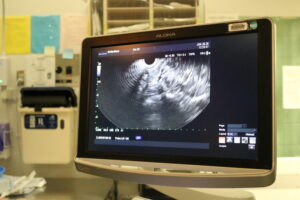 Extremely rare procedure performed at St. B
St. Boniface Hospital can also use the new ultrasound scopes for more advanced, specialized procedures in some cases. In fact, Dr. Moffatt and Dr. Gerard Coneys performed a first-of-its-kind procedure in Western Canada cancer treatment in November 2025 at the Hospital.
The patient was 94 years old and considered too frail for surgery to treat their type of cancer, a tumour of the insulin-producing cells in the pancreas. The tumour was small; only about one centimeter in size.
“Traditionally, if this person had been (middle aged), they’d come in with this problem, they would have had a more invasive surgery to remove part of their pancreas,” said Dr. Moffatt. “We still think surgical removal of these tumors is the better option if you can have the surgery.”
Instead, with his elderly patient, Dr. Moffatt used the ultrasound scope to put a needle directly into the small tumour. He then had the option to either inject a chemical agent to kill it, or use energy called radiofrequency ablation to destroy the tumor locally, both without having to do an operation.
“We found the tumor with the endoscopic ultrasound. We put a needle across the stomach wall into the tumor in the pancreas, and we injected 100 per cent ethanol to kill the tumor. And it worked beautifully. Their insulin levels dropped, their sugars went up to normal, and we discharged them from the Hospital just three days later,” he said.
The procedure, performed only a few times elsewhere in Canada, was not without risk. “We had to go in eyes wide open,” added Dr. Moffatt. “This was unpredictable in the response. Was this going to fix the problem, do nothing at all, or cause a bigger problem?”
“Luckily, only the good things happened. There were no complications, no pain, no recovery time. The patient was feeling fine and eating that same day.”
“It is still a very new procedure. But in patients that can’t have surgery for pancreatic tumors of this type, yes, absolutely we are keen to try this again and offer this as an option.”